


Ad Creative Naming Conventions for Meta Ads: A Scalable System for Creative Testing & Reporting


.png)
Running paid traffic campaigns effectively demands proper planning and structure. Without a specific format, teams tend to waste time figuring out which creatives work. A standardized system for your Ad Creative Naming Conventions helps ensure consistency across teams, making it easier for marketers and designers to make sense of performance metrics and turn reporting dashboards into insights.
Why Ad Creative Naming Conventions Matter for Meta Advertising Teams
Creative testing is at the core of modern digital marketing. Industry data shows that creative execution accounts for approximately 50-70% of campaign effectiveness. Naming conventions help prevent misreporting and miscalculations, ensuring data is precise and reports are accurate, helping teams pick out winning creatives without the need for messy spreadsheets.
What Are Ad Creative Naming Conventions?
Ad Creative Naming Conventions Framework is a systematic way to name campaigns, audience segments, creatives, and assets. With placeholders and separators in the names, all team members can understand everything about the asset from the name itself.
5 Essential Rules for Building Scalable Naming Systems
Rule 1: Generate Naming for Reporting, Not Readability Only
Naming conventions must be built for automation purposes, not just aesthetic appeal. Standardization facilitates proper classification, distinction, and analysis of information.
Rule 2: Create an Effective Name Convention for All Teams
Ensure that the designers, copywriters, and media planners all follow the same naming standard. In this way, communication is ensured to be effective and smooth.
Rule 3: Use Consistent Terminology and Abbreviations
Follow the same glossary and dictionary. Stick to the abbreviations throughout all campaigns, for instance, PUR for Purchase and VID for Video.
Rule 4: Implement Clear Versioning for Creative Tests
Mark the innovative variations simply using numbers such as V01, V02, and V03. It will be easier to determine which variations increase efficiency.
Rule 5: Keep Automation-Friendly Names
Spaces must not be incorporated in the text. Only letters and numbers can be used.
The 4 Layers of Meta Ad Naming
To maintain structure, your meta ads naming convention template needs to be implemented within four levels of organization:
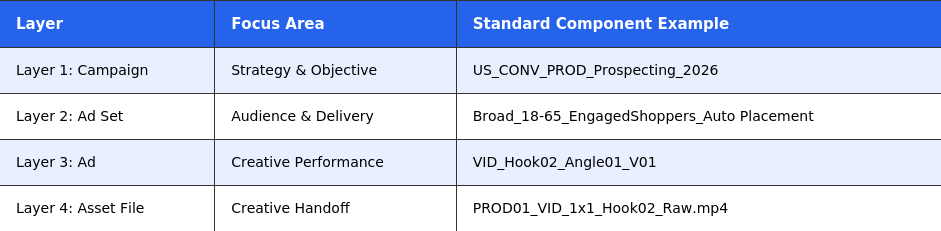
Layer 1: Campaign Naming (Strategy Level)
Layer 1 outlines the entire campaign strategy, including country, marketing goal, product line, and funnel stage.
Layer 2: Ad Set Naming (Audience & Delivery Level)
The creative testing naming convention must include information about the audience, including audience type, demographics, and audience optimization settings.
Layer 3: Ad Naming (Creative Performance Level)
This Layer tracks creative execution by identifying the format, angle, emotional hook, and copy version for effective testing.
Layer 4: Asset File Naming (Creative Handoff Level)
The naming system for creative assets must be consistent with the ad name to enable easy collaboration and workflow optimization.
How to Use Platform-Specific Naming Features
- TikTok: Naming Templates (Ad Group Level Only): TikTok's dynamic naming applies at the ad group level only, requiring manual naming for individual ads.
- Meta: Naming Templates Exist, But Don't Rely on Them Alone: Meta Ads Manager offers automated naming, but it doesn't capture creative angles or strategic insights. Combining automation with manual analysis would result in better reporting.
How Adnova Simplifies Ad Naming and Creative Management
- Standardize Naming Across Campaigns: Adnova helps enforce naming conventions through its setup feature, thus preventing human mistakes, and ensuring all creatives follow the correct format.
- Improve Reporting Accuracy: Adnova's AI-powered creative tagging automatically links creatives to campaigns for accurate reporting without manual naming conventions, while supporting existing naming structures for consistent performance insights.
- Streamline Creative Testing Workflows: Minimizing administrative burden and making creative testing easier in a large-scale environment.
Best Practices for Rolling Out Naming Conventions Across Teams
- Create a Centralized Naming Guide: These acronyms and coding frameworks must be documented in an easily accessible "single source of truth" document by your team.
- Maintain a Shared Vocabulary List: Make sure that the master spreadsheet for concepts, hooks, and product line is up-to-date and consistent with the list.
- Incorporate Naming Checks into Launch Processes: Incorporate structural validation into your QA process. You should never launch any campaigns without first validating the formatting.
Conclusion
Organized and clean systems are essential for scalable marketing efforts. Consistency in naming will allow us to get clear information and make decisions easily. Adnova helps teams organize and manage the process of naming Meta advertisements, connecting asset management with performance reporting.
By optimizing creative variables and simplifying workflows, Adnova enables media buyers to develop effective processes that provide them with insights into creative testing.
Faqs
- What should be included in Meta ad naming conventions?
Comprehensive naming formulas should include multiple strategic elements, including the destination country, objective type, audience information, format, angle, and version code.
- How long should Meta ad names be?
Keep your parameter sets brief yet descriptive. The number of parameters must be between 4 and 7, delimited by commas, and should not exceed the Meta interface margins.
- Why are UTM naming conventions important for Meta ads?
UTM naming conventions for Meta ads should be used correctly to link external analytics with your ad manager data.