


Adnova vs Atria: Which One Is a Better Creative Analytics Platform?


.png)
Choosing a creative analytics platform is no longer a "nice to have" decision. With performance marketing leaning more heavily on creative as the new targeting, the tool you pick decides how fast your team can read signals, react to data, and ship the next winning ad. Two of the most talked-about names in this space right now are Adnova and Atria. Both promise creative analytics, competitor intelligence, and a workflow that gets ads out the door faster, but once you look under the hood, the differences are pretty significant.
In this blog, we break down both platforms across the features that actually matter to performance creative teams: reports, AI capabilities, competitor tracking, asset management, ad launchers, support, and pricing. By the end, you'll have a clear answer on which one fits your team better.
What is Adnova?
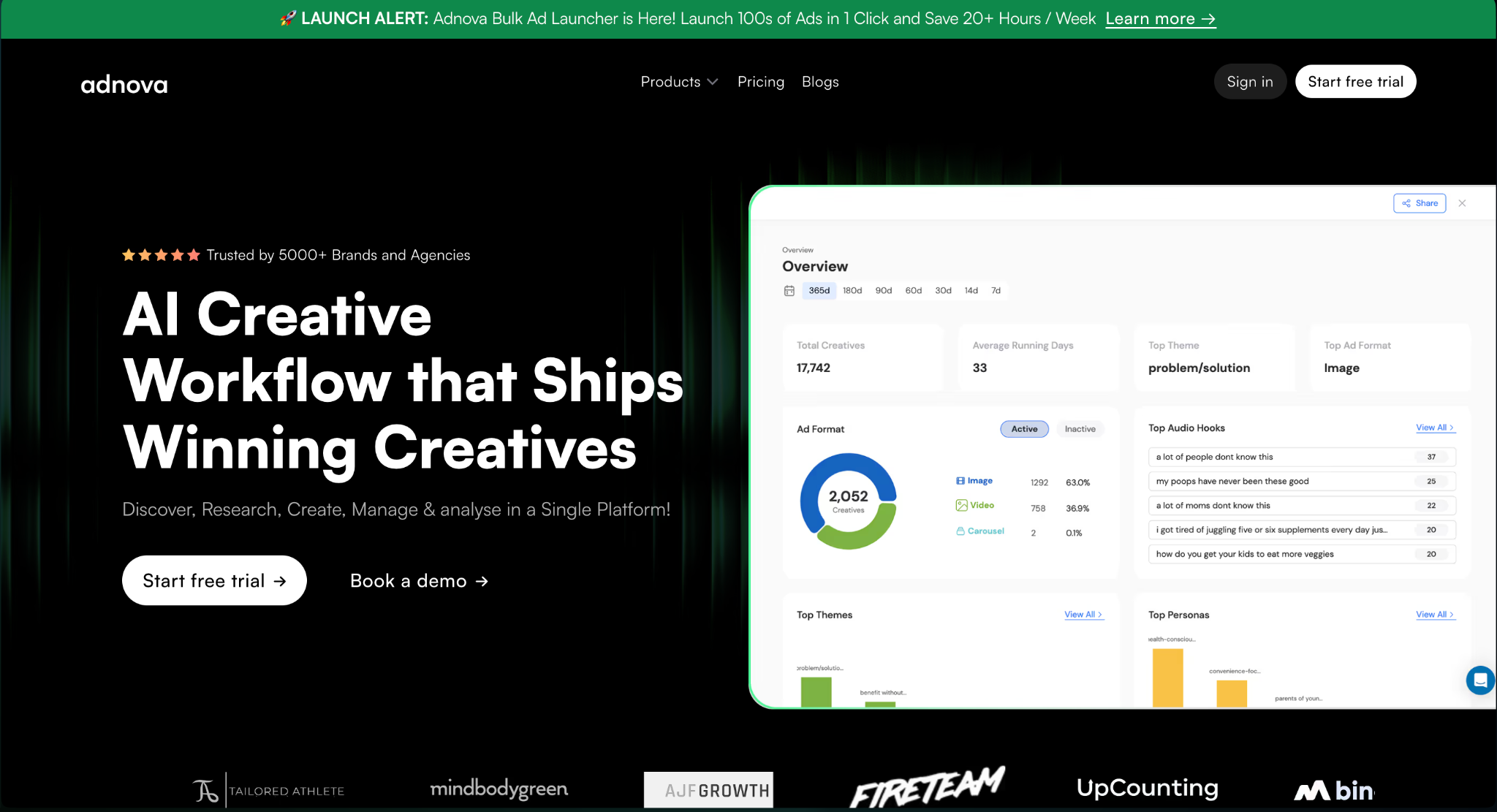
Adnova is an AI-powered creative strategy platform built for performance creative teams, agencies, and DTC brands. It brings together five core capabilities under one roof: creative analytics, an ad inspiration library with millions of ads, the Detective competitor intelligence, the Creative Hub for review, feedback, and versioning, and a Bulk Ad Launcher that lets teams ship 100+ ads in a single click.
Adnova is used by over 5,000 brands and agencies worldwide and is best known for replacing a multi-tool stack, Motion, Foreplay, Frame.io, MagicBrief, and others, with a single, integrated workflow.
What is Atria?
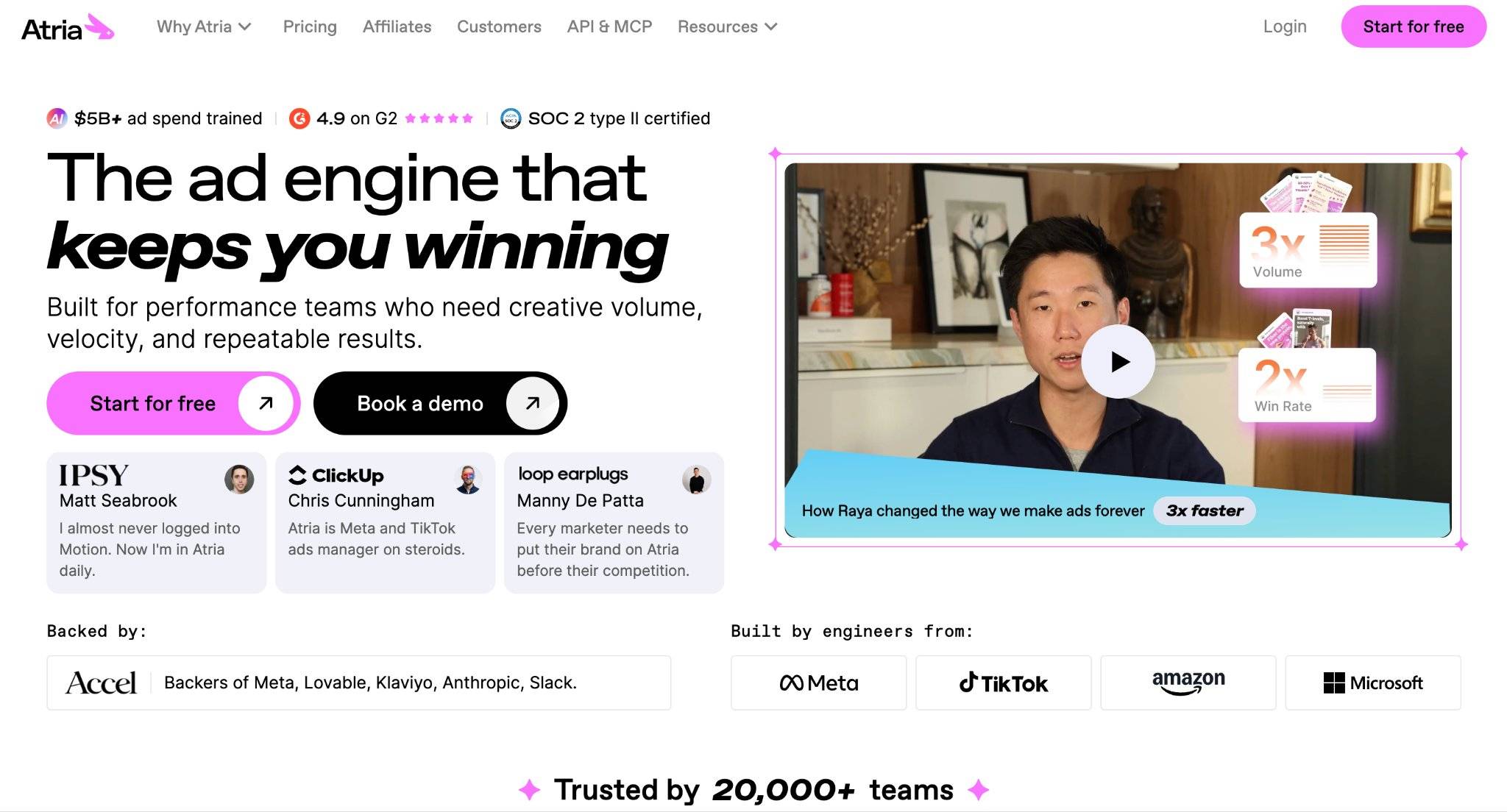
Atria is an AI-powered ad intelligence platform built primarily for Meta and TikTok advertisers. Its main pillars are Radar, an AI analytics engine that surfaces winners and losers in your account; an ad library for competitor research; Review Mining, which pulls customer review insights into creative angles; and Raya, an AI creative strategist agent that generates briefs, scripts, and image variants.
Atria is positioned more as an "AI-first" workflow, leaning heavily on generative tooling and an AI agent to drive recommendations. It's well-suited for solo performance marketers and small teams that want generative AI baked into their analytics workflow.
Reports Available
- Top performing reports: best creatives by spend, ROAS, CTR, and key metrics
- Comparison reports: side-by-side analysis of campaigns, ad sets, or time periods
- Launch/compass reports: status of recently launched creatives, so winners and losers surface fast
- Period-over-period analysis: same creatives across two date ranges to spot fatigue and momentum
- AI tagging: automated breakdown of each ad by hooks, themes, formats, and personas
Adnova also ships with a first-party Northbeam integration, so attribution-aware brands can layer Northbeam's revenue data on top of creative breakdowns instead of running two separate reports.
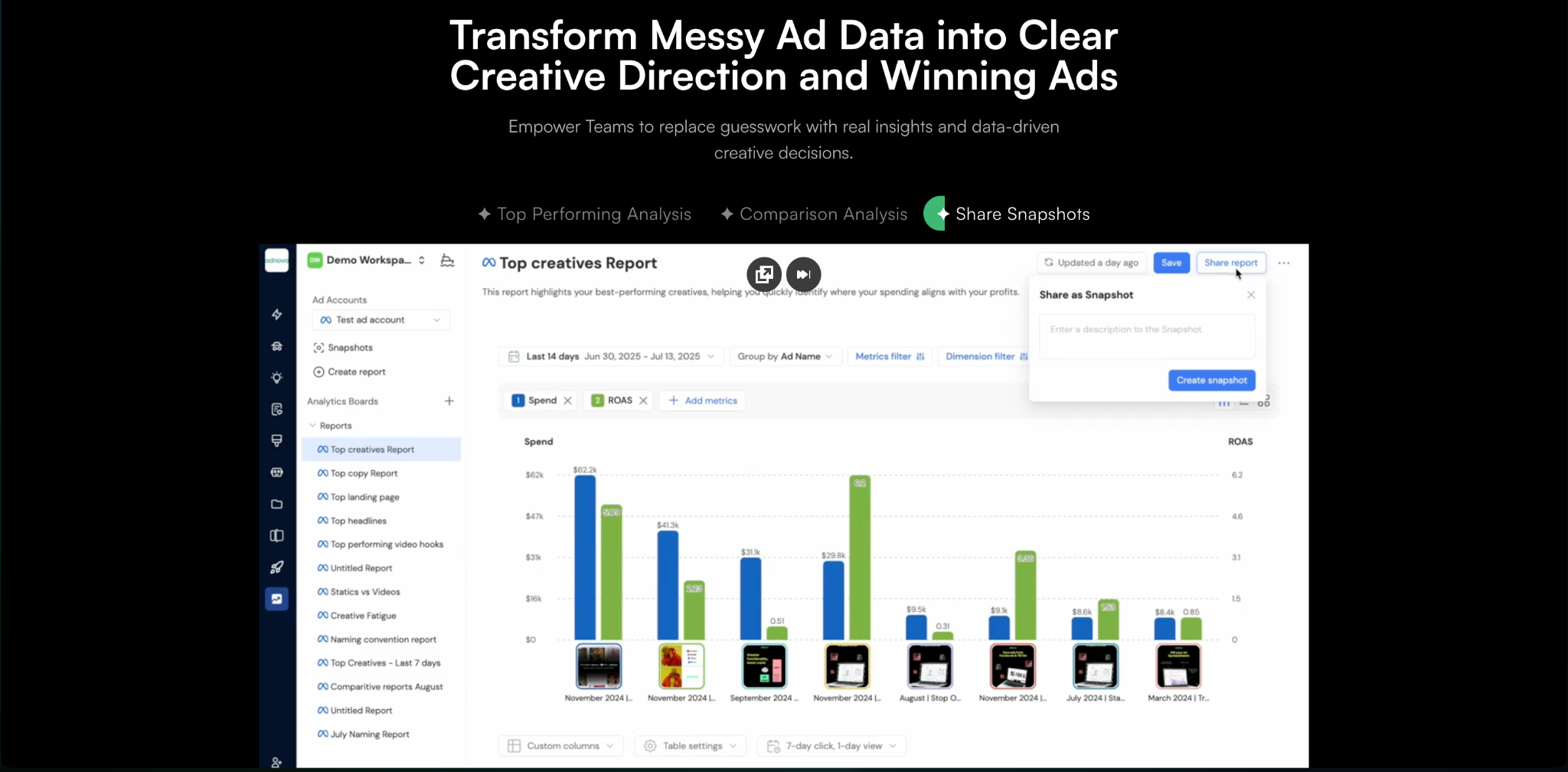
Verdict: Both platforms cover the core reporting needs well. Adnova edges out for teams with first-party data integration and MCP API.
AI Features
Adnova's AI is distributed across the entire workflow:
- AI tagging powers analytics reports
- AI-powered search drives the inspiration library
- Brand following uses AI to break down competitor creatives across multiple dimensions
- Review mining pulls customer reviews and ad comments.
- All this data can be connected to Claude, ChatGPT, or Manus to be discussed further.
Atria's AI is concentrated in research and ideation:
- Radar grades creatives on hook effectiveness, retention, and ROAS
- Review Mining pulls customer reviews and extracts emotional triggers
- Raya generates scripts, hooks, and image variations from prompts or reference ads
Verdict: Atria concentrates AI in research and ideation. adnova distributes it across every step of the creative lifecycle. Both are credible, the right choice depends on where you want the AI to show up.
Competitor Tracking
Adnova's brand follows 24/7 competitor Meta ad tracking and delivers AI insights across 14+ dimensions: ad angles, persona, USPs, audio hooks, visual hooks, headlines, ad copy, landing pages, themes, scripting (tone and emotion), objects and background analysis, and media mix.
Atria offers a comparable competitor tracking experience built around AI-tagged elements like hooks, ad angles, personas, USPs, desires, emotions, and themes. However, AI-tagged brand insights are gated to the Plus plan and above, Core users only get the basic library and saving experience.
Verdict: Adnova's brand following is more comprehensive out of the box, with deeper dimensions and longer historical look-back, and the full feature set is available without forcing an upgrade to a higher tier.
Asset Management
Adnova's Creative Hub is built around team review and feedback:
- Timestamp-based comments on videos
- Visual annotations on creatives
- Version history tracking
- Unlimited feedback rounds
- Centralized review cycles in one place
Atria's Creative Asset Management Hub is built around AI search:
- AI-powered search across creatives
- Commenting threads
Verdict: If your bottleneck is finding the right reference, Atria is useful. If your bottleneck is shipping creatives through structured review cycles, adnova is purpose-built for that.
Ad Launcher
Adnova's Bulk Ad Launcher offers:
- Platforms: Meta, TikTok, AppLovin
- Formats: single image, single video, carousel, catalog, flexible ads, multi-placement with auto-grouping
- Sources: Google Drive, Dropbox, existing Meta ads, organic posts, Creative Hub
Atria's ad launcher offers:
- Platforms: Meta only
- Batch upload to Meta is not available yet.
- Advanced access controls and cross-account analysis are not available.
Verdict: For agencies running across multiple platforms, or DTC teams shipping into Meta, TikTok, and gaming inventory like AppLovin, adnova's launcher is the more practical and flexible choice.
Support Team
Adnova is widely recognized in the community for responsive, hands-on support. Customers can reach the team via live chat, dedicated slack channel, email, and a knowledge base, with founder-led demos available through Calendly.
Atria's support experience has drawn more mixed reviews publicly. On Trustpilot, multiple users have reported issues such as the cancel button not working on the website, support not responding to emails about refunds or unwanted charges, and being auto-upgraded. Independent reviewers note these are isolated reports and not universal, but the pattern is worth knowing about before signing up.
Verdict: Adnova's support reputation is one of its strongest selling points. If support responsiveness matters to your team, this is a meaningful differentiator.
Pricing
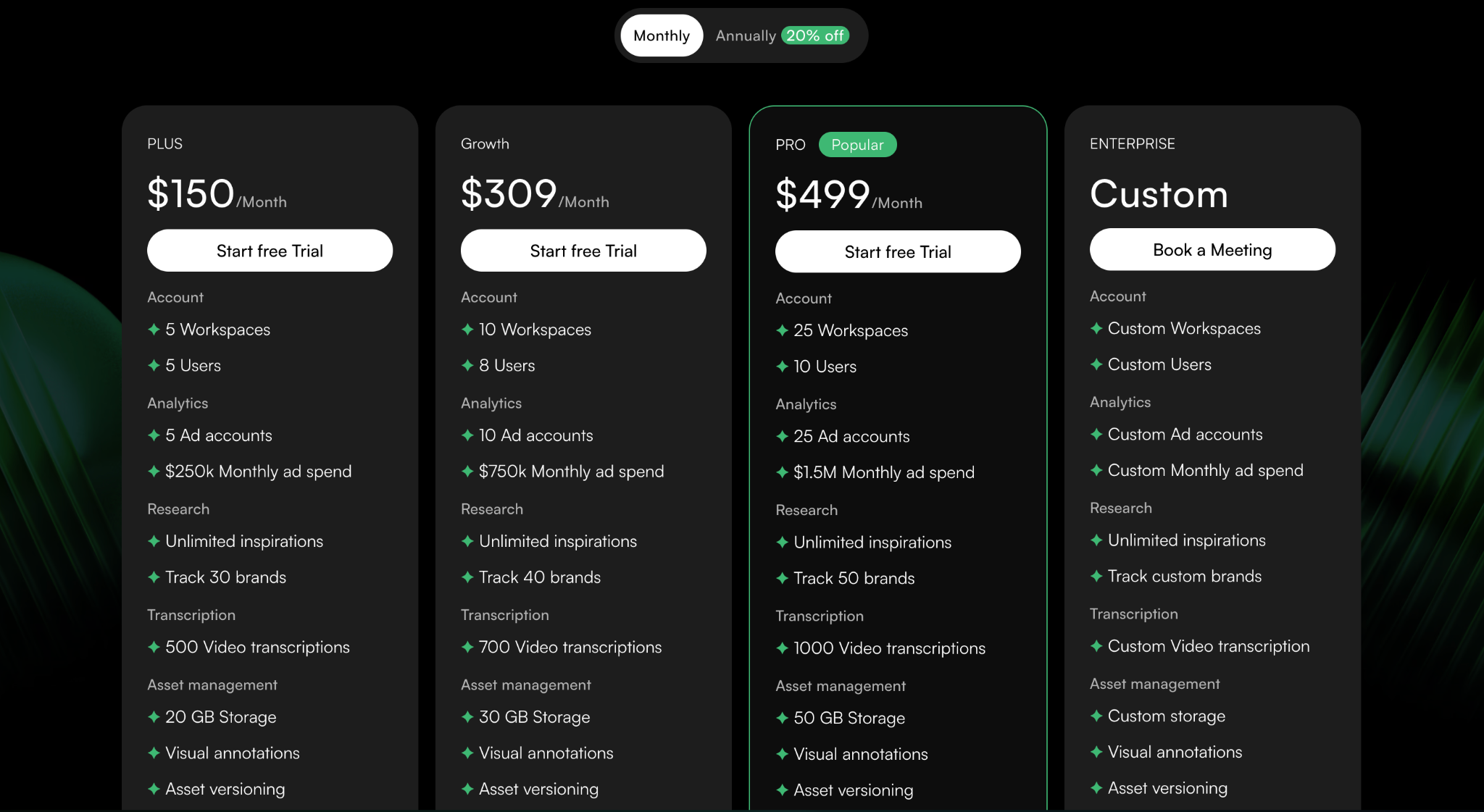
Adnova Plans
Adnova uses a transparent tiered pricing model published on its site. Each plan includes a monthly ad spend cap, a set number of ad accounts, and user seats, with caps and features scaling up at higher tiers. Self-service cancellation is available on all plans.
- Free ($0/month): Limited access to inspirations and analytics for individuals exploring the platform
- Plus ($150/month): Includes $250K monthly ad spend tracked, 5 ad accounts, 5 users, and the full creative analytics suite
- Growth ($309/month): Includes $750K monthly ad spend tracked, 10 ad accounts, 8 users, and all features in the Plus plan
- Pro ($499/month): Includes $1.5M monthly ad spend tracked, 25 ad accounts, 10 users, and all features in the Growth plan
- Enterprise (Custom): Flexible plan supporting $10M+ in monthly ad spend, custom workspaces, dedicated account management, and priority support
Atria Plans
Atria uses a tiered seat-and-ad-spend model. Each plan includes a fixed number of seats, connected ad accounts, and an ad spend cap, with extra seats available at $20/seat/month across all plans. AI credits and brand-following limits scale up at higher tiers.
- Core ($159/month): Includes $500K monthly ad spend tracked, 5 ad accounts, 5 seats, 4,000 AI credits, and Radar AI analytics
- Plus ($599/month): Includes $1M monthly ad spend tracked, 10 ad accounts, 8 seats, 10,000 AI credits, and all features in the Core plan
- Business ($1,199/month): Includes unlimited ad spend, unlimited ad accounts, 15 seats, 25,000 AI credits, and all features in the Plus plan
- Enterprise (Custom): Custom plan with end-to-end creative delivery, enterprise-grade security, and dedicated support
Both tools publish their pricing, but the gap is meaningful. The entry tiers land within a few dollars of each other, but adnova pulls ahead at the mid and scaled tiers, coming in roughly $290/mo cheaper than Atria Plus and $700/mo cheaper than Atria at top tier. Atria's higher tiers do include uncapped ad spend, which is genuinely useful if you're already operating well above $5M per month. For most performance teams in the $250K-$3M range, adnova is the more economical choice while still bundling analytics, asset management, competitor tracking, and multi-platform ad launching.
Try Adnova
If you're choosing between the two, here's the honest take: both are capable creative analytics platforms, and Atria is a strong product in its own right, especially if agentic AI sits at the center of your workflow. But across the board, reports, competitor tracking, asset management, ad launcher flexibility, support reputation, and pricing transparency. Adnova consistently delivers more value per dollar and more predictable workflows.
The fastest way to know if Adnova fits your workflow is to try it on a real launch. No credit card required.
Or, if you'd like a walkthrough with the team to map Adnova against your current setup:
Book a call with the Adnova team