


Adnova vs MagicBrief: Which One Is a Better Creative Analytics Platform?


.png)
If you run paid social at any kind of scale whether you're a DTC brand, a performance agency, or an in-house creative team you've felt the same pain. Your ad account has the answers, but they're buried under columns of CTR, ROAS, hold rate, and thumbstop ratios that no one has time to actually decode. Creative analytics tools exist to fix that.
Adnova and MagicBrief. Both turn raw ad data into creative insight. But under the hood, they take very different approaches, and they sit at very different price points.
This is a side-by-side breakdown, focused on the things that actually matter when you're spending real money on ads every month: reports, data reliability, shareability, competitor research, support, and pricing.
What Is Adnova?
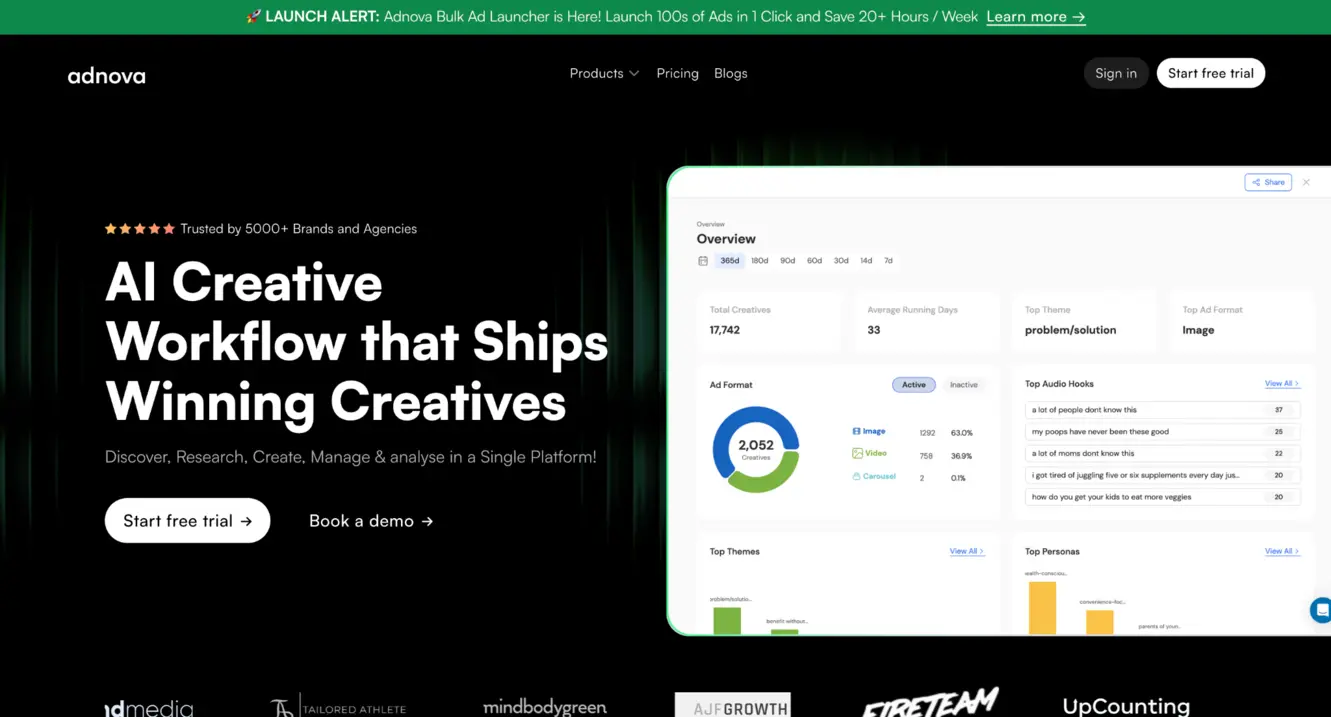
Adnova is an all-in-one creative platform built for performance marketing teams running ads on Meta and TikTok. It bundles together five things most teams cobble together from separate tools: creative analytics, an ad inspiration library, a competitor intelligence layer (called Detective), a Creative Hub for review and feedback, and a Bulk Ad Launcher that publishes 100+ ads to Meta in a single click.
Adnova is used by 5,000+ brands and agencies and supports modern integrations like a native MCP server and a public API, meaning teams can pull their creative data straight into Claude, ChatGPT, or a custom internal dashboard. Pricing is published openly, with paid plans starting at $150/month.
What Is MagicBrief?
MagicBrief is a creative intelligence platform, focused on creative analytics, ad research, and modular briefing for performance marketers. It connects to Meta, TikTok ad accounts and pulls in performance data alongside an ad library of 12 million+ ads from 50,000+ brands.
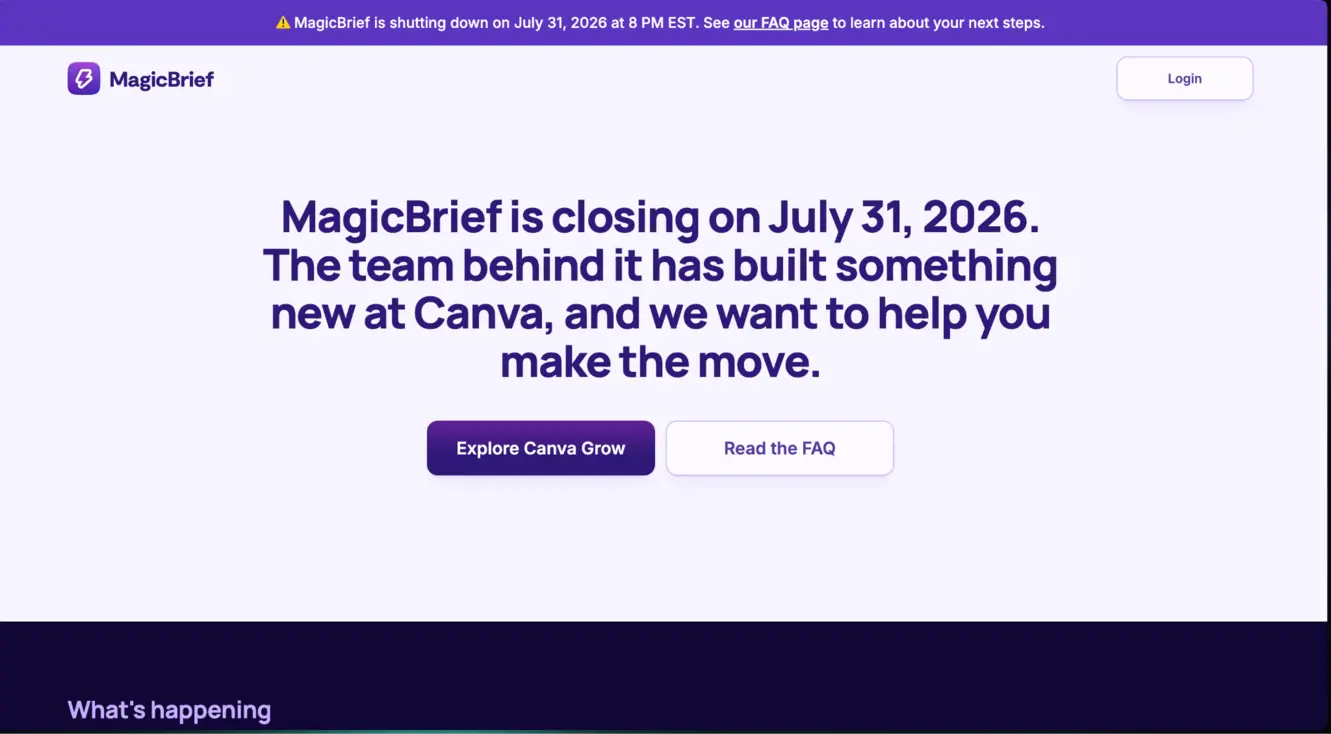
In June 2025, MagicBrief was acquired by Canva, the Australian design giant and is publicly announced to sunset their product by July 31st 2026.
Creative Reports
Adnova ships with five distinct report types out of the box:
- Top Performing Report surfaces your best creatives ranked by the metrics you care about.
- Comparison Reports pit hooks against hooks, themes against themes, formats against formats, so you can see what's actually moving the needle.
- Compass Report a quick view of every recently launched creative and its current status, so creative teams aren't flying blind on what just shipped.
- Period-over-Period Report tracks creative momentum across time windows so you can spot when a winner is fatiguing or when a sleeper is starting to scale.
- Custom Reports built on top of Adnova's API and MCP pipe your data into Claude, ChatGPT, or Claude Code to spin up bespoke dashboards that look the way your team works.
Adnova also ships with a first-party Northbeam integration, so attribution-aware brands can layer Northbeam's revenue data on top of creative breakdowns instead of running two separate reporting.
MagicBrief offers comparison reports, top-performer breakdowns, and competitor reporting with automated Slack summaries, but it doesn't currently advertise launch-analysis or period-over-period as distinct report types in the same way Adnova does. It also doesn't ship with a public MCP or open API for building custom analytics on top.
For most teams, the practical difference is this: with Adnova, the reports your team actually need ("what just launched? what's losing momentum?") already exist with just a few clicks.
Data Reliability
Creative analytics is only useful if the numbers are right. A tool that quietly miscounts spend or misattributes a winner is worse than no tool at all, it actively makes you worse at your job.
Adnova has built a reputation among its 5,000+ users for clean, consistent data syncs from Meta and TikTok. Spend, impressions, ROAS, and conversion data line up with what you'd see in Ads Manager.
MagicBrief is a respected platform with a strong product, and the majority of its public reviews are positive. That said, it's worth doing what every buyer should do regardless of which tool: during your trial, sync a real ad account and reconcile a few key reports against Ads Manager directly. This is good practice for any third-party analytics tool, not a knock on either platform but it's the single best way to catch reporting issues before you build a workflow on top of the data.
Shareability
Creative reporting only delivers value if the right people see it, clients, founders, creative leads, freelancers building the next round of variations.
Adnova lets you generate shareable snapshots of any report, a static, link-based view that locks the data at a point in time. Drop the link in Slack, paste it into a client email, or send it to a freelancer alongside the brief. No login needed for viewers, and no risk of someone editing the report after the fact.
MagicBrief also supports public share links and Slack updates, so reports and competitor activity can be pushed out to the team. The functionality is there.
Inspiration and Brand Tracking
Both tools are strong here. Both let you swipe ads from Meta and TikTok ad libraries, organize them into boards, and reference them when briefing.
The differentiator shows up in competitor tracking.
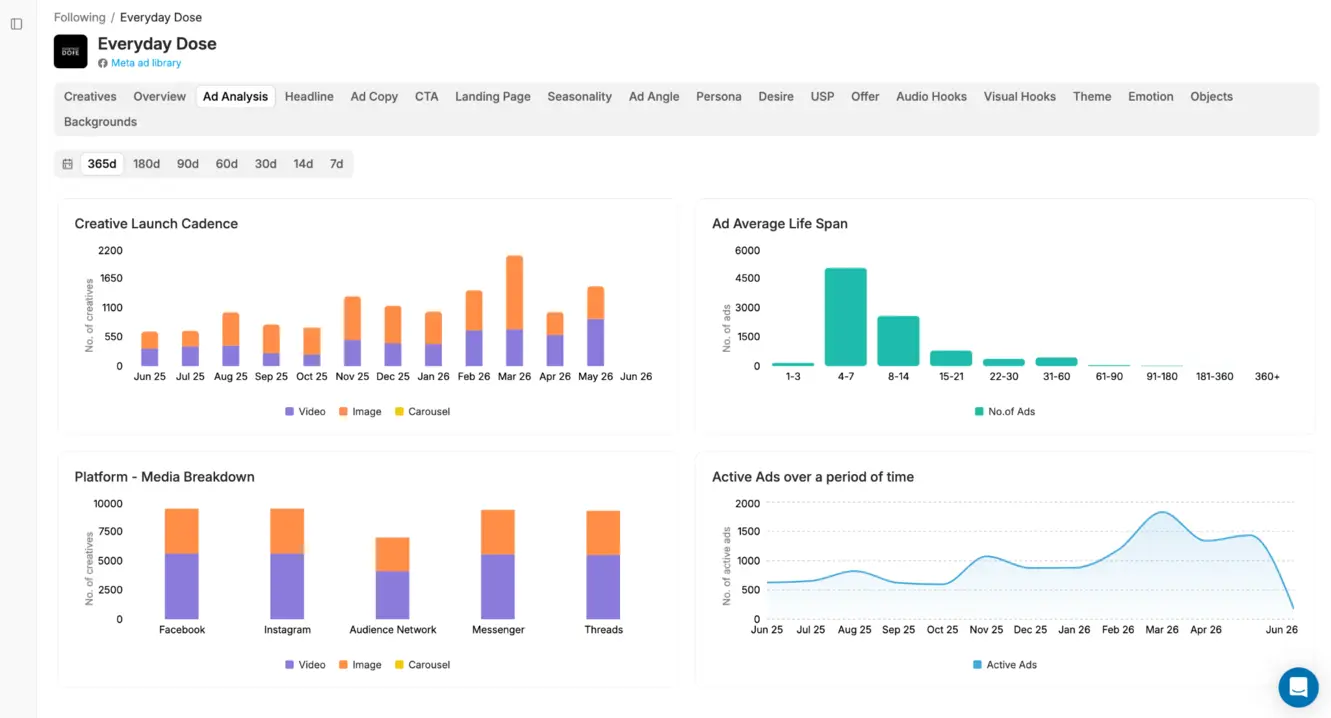
Adnova's Brand Following feature is built around an AI-driven creative breakdown of any brand you choose to follow. Point it at a competitor's Meta Ad Library page, and it returns a structured analysis of their creative strategy: ad angles, personas, USPs, audio hooks, visual hooks, headline patterns, scripting tone and emotion, themes, and even objects and backgrounds detected in the creative. You're not just seeing what they're running, you're seeing the strategic logic underneath it.
MagicBrief offers competitor tracking, theme/hook analysis, and automated competitor summaries through MagicAI. It's a solid feature set, particularly for teams who want a quick read on what brands are testing. The depth of breakdown, the structured "this is their entire strategic playbook" output is where Adnova's brand following goes further.
Support Team
This sounds soft until you need it on a Friday at 6pm before a client meeting.
Adnova offers 24/7 support across three channels: live human chat in-app, dedicated Slack channels for paying customers, and email. The team has been called out by name in user testimonials - Praveen, Adnova's founder, regularly shows up in public reviews on X and LinkedIn for being personally responsive to customer issues.
MagicBrief offers dedicated account management and Slack channels on all plans, per their own site. Public reviews are generally positive on responsiveness, though the depth and speed of support relative to Adnova is something worth pressure-testing in a trial.
If support quality matters to you - and at this price point, it should - talk to both teams during your evaluation and see how fast you actually get a useful response.
Pricing
This is the cleanest comparison in the entire post, because both companies' starting prices are public.
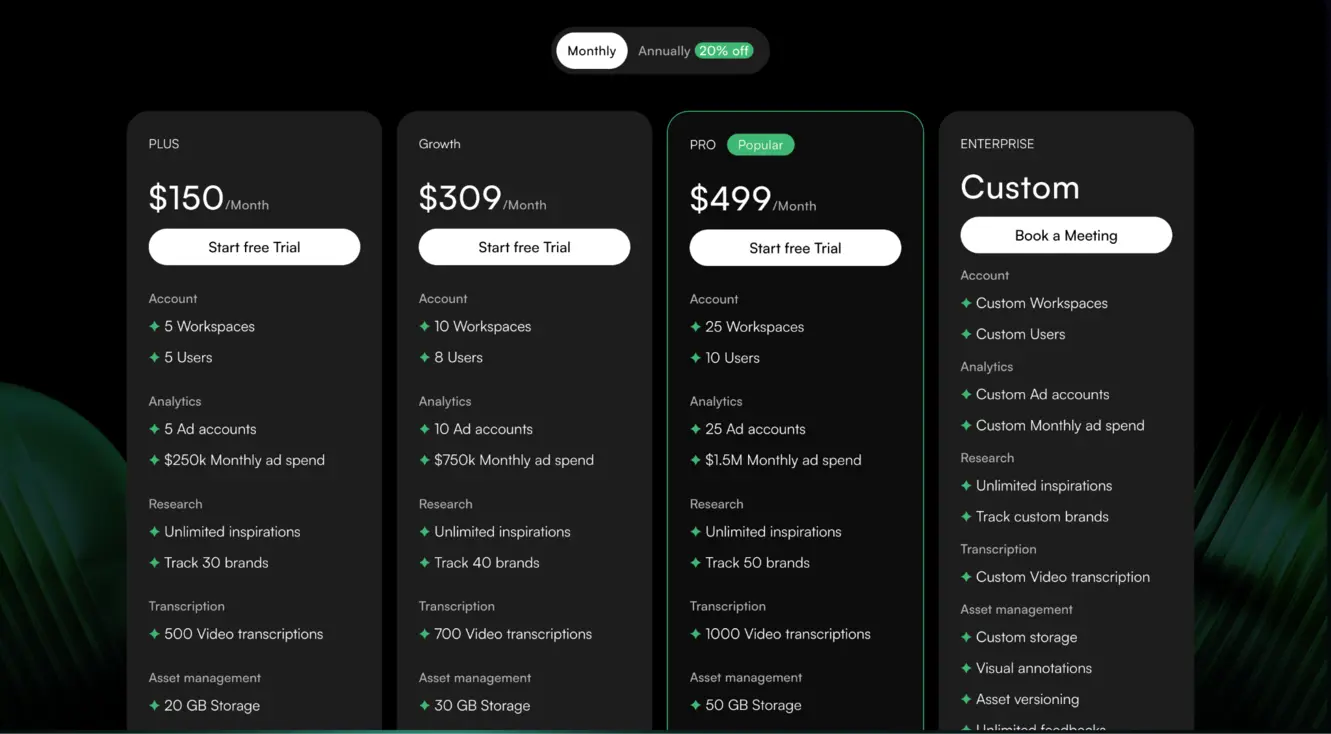
Adnova publishes its pricing transparently on the website:
- Plus - $150/month (monthly) or $119/month (annual) - 5 ad accounts, $250K monthly ad spend, 5 users, 5 workspaces.
- Growth - $309/month (monthly) or $249/month (annual) - 10 ad accounts, $750K monthly ad spend.
- Pro - $499/month (monthly) or $399/month (annual) - 25 ad accounts, $1.5M monthly ad spend.
- Enterprise - custom.
You can sign up, start a 7-day free trial, and pay with a credit card. No sales call required.
MagicBrief uses ad-spend-based pricing starting at $249/month for the Pro plan, but the actual price is customized based on ad spend and team size - meaning you have to fill out a form and wait for a quote. There's no self-serve checkout for the main analytics product, and no published price for higher tiers (the "Creative Intelligence" enterprise tier is invoice-based and quote-only).
For a team running $250K/month in spend, the practical math looks like this:
- Adnova Plus - $150/month, billed transparently, signup in minutes.
- MagicBrief Pro - starts at $249/month, but the real price depends on a sales conversation.
Adnova is materially cheaper at the entry tier, and you can compare the full feature list against your needs without getting on a call. That's a meaningful difference in how the two companies treat smaller and mid-market buyers.
Why should you choose adnova?
MagicBrief is shutting down on July 31, 2026. If you're a current MagicBrief user, you have a hard deadline to:
- Export every report you want to keep.
- Save any inspiration boards, briefs, and competitor research you've built up over months or years.
- Pick a new home for your creative analytics workflow before the lights go out.
After July 31, the platform is gone, and per MagicBrief's own FAQ, data inside it cannot be recovered.
This is where the case for Adnova is most concrete. For teams making a fresh choice or migrating off MagicBrief, Adnova checks every box that mattered before and solves the urgency:
- Free migration support. Adnova's team will help you move your assets, saved ads, reports, and creative workflows over from MagicBrief at no charge. You email support@tryadnova.ai and they handle the heavy lifting before the July 31 deadline.
- More report types out of the box - Top Performing, Comparison, Launch Analysis, Period-over-Period, plus a Northbeam integration and an MCP/API for custom dashboards in Claude or Claude Code.
- Deeper competitor intelligence via Detective's structured creative-strategy breakdowns.
- Transparent, self-serve pricing starting at $150/month, with no mandatory sales call.
- Active product velocity and a hands-on support team - Adnova ships updates frequently, and the founder is publicly accessible to customers.
- All-in-one workflow - analytics, inspiration, Detective, Creative Hub, Ad Templates, and a Bulk Ad Launcher in one platform, replacing a stack of separate tools.
If your team is on Canva for design and wants to wait and see what Canva Grow becomes, that's a defensible path - but it comes with the cost of running without a creative analytics tool for some period, and re-learning a new product from scratch when it does land. For most performance teams, the lower-risk move is migrating to a stable, mature platform now, keeping your data and continuity intact, and getting back to shipping ads.
Migrate to Adnova Before July 31 - Free
Adnova offers free migration support for teams moving off MagicBrief. The team will help you bring over your saved ads, reports, briefs, and workflows so you don't lose anything when MagicBrief shuts down.
Start your free 7-day trial - no credit card required. Sync your ad account, see the reports running on your real data, and decide before you commit.
Want a hand with the migration directly? Book a call with the Adnova team or email support@tryadnova.ai - they'll walk you through the move and make sure nothing falls through the cracks before July 31.