


Hunch vs Adnova: Which Ad Tool Actually Fits How Your Team Works?


.png)
If you run a Meta-first ad agency or a DTC brand, you've probably hit the same wall: the modern paid-social workflow is fragmented across too many tools. You research competitors in one app, store creative briefs in another, review assets in a third, analyze performance in a fourth, and bulk-launch ads. Each one bills you separately. Each one trains your team differently.
Two platforms come up often when teams try to fix this Adnova and Hunch. They're both labeled "ad platforms", but they were built for fundamentally different problems. Picking the wrong one wastes budget; picking the right one compresses a week of work into a day.
This breakdown walks through what each tool actually does, where they overlap, what they cost, and which kind of team each one fits.
What is Adnova?
Adnova is an AI-powered creative workflow platform for performance marketers running Meta ads. It bundles five distinct workflow needs into a single subscription: ad inspiration, competitor tracking, creative analytics, asset review and collaboration, AI tagging, plug-and-play templates, and bulk ad launching.
Adnova is self-serve. Pricing is published, a free trial is one click, and onboarding doesn't require a sales call.

What is Hunch Ads?
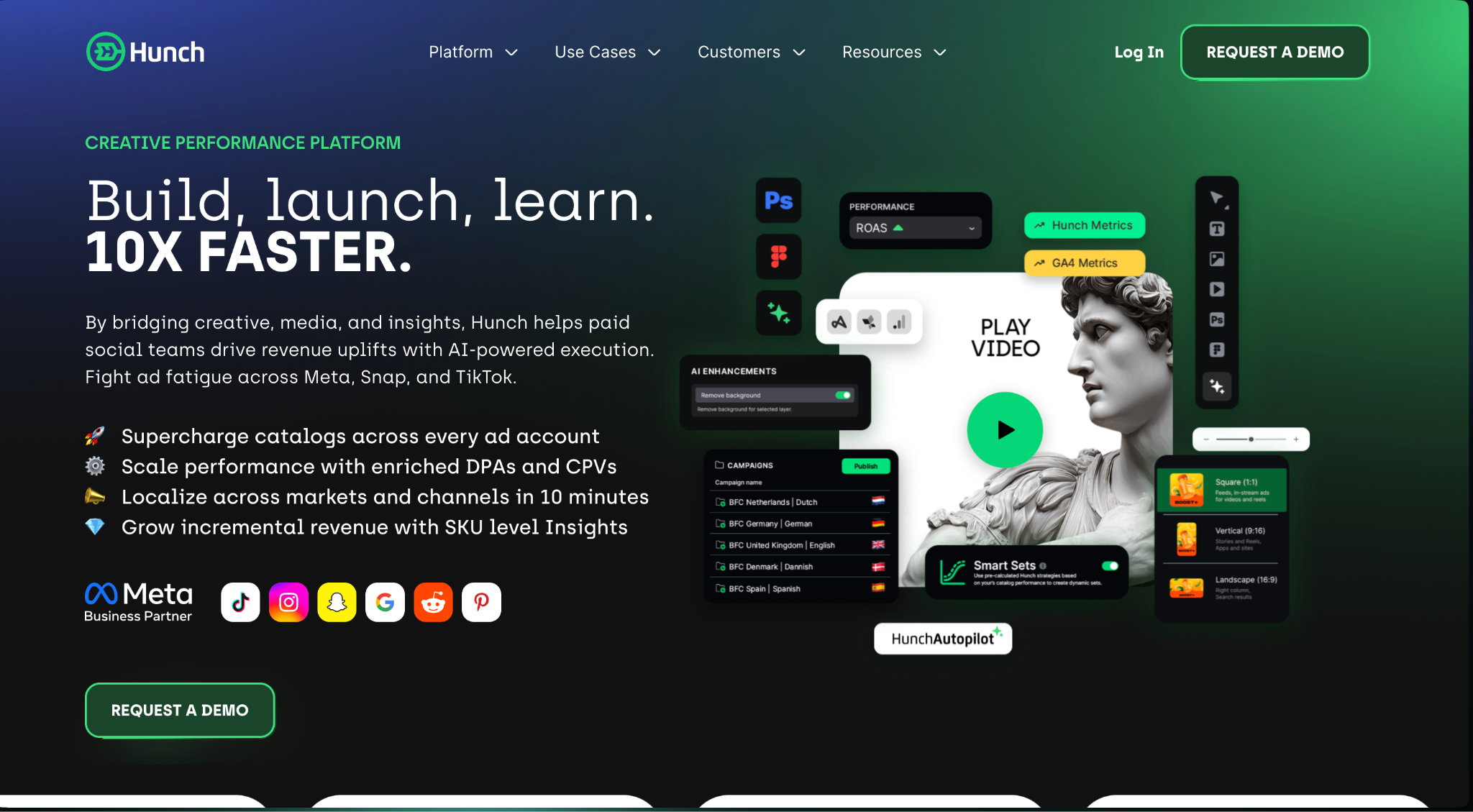
Hunch is a Creative Performance Platform built for brands and agencies running large product catalogs on paid social. It's an official Meta Business Partner and positions itself around three core pillars: Creative, Media, and Insights, unified into one system.
Hunch is sold through demos, and the company emphasizes hands-on onboarding, dedicated strategists, and ongoing Slack support as part of the engagement.
What is Each One Built to Solve?
The two products were designed around different bottlenecks.
Hunch was built to solve catalog-scale execution. If you sell thousands of SKUs, run always-on campaigns across multiple markets, and lose hours to manually rebuilding ad sets every time your inventory or pricing changes, Hunch is the answer. It turns one template into thousands of localized, dynamic, on-brand ads and publishes them natively to Meta and Snap. The pain it removes is the manual labor of running a large e-commerce or marketplace catalog on paid social.
Adnova was built to solve creative workflow fragmentation. If your team's bottleneck isn't catalog automation but rather the dozen tools you're stitching together, one for inspiration, one for competitor research, one for asset review, one for templates, one for analytics, one for launching, Adnova consolidates that stack. The pain it removes is the friction of context-switching, multiple subscriptions, and disjointed handoffs between research, review, launch, and analysis.
For a DTC founder running a single product line with 50 SKUs, catalog automation isn't the bottleneck. The bottleneck is shipping enough winning creatives, fast enough, while keeping the team aligned. For a Meta agency managing eight to ten client accounts, the bottleneck is the same, plus competitive intelligence and reporting at scale. Adnova is built around that reality.
Feature Coverage Side by Side
.png)
The split is clean. Adnova covers everything that happens around the creative, finding it, analyzing it, reviewing it, templating it, and launching it. Hunch covers everything that happens when a product catalog needs to become thousands of localized, dynamic ads.
Where They Overlap
There are only two genuine areas of overlap between the two products, and even there, the approach differs.
Bulk Meta ad launching. Both tools eliminate the grind of Meta Ads Manager. Adnova's Bulk Ad Launcher takes a creative-first approach: upload assets from Drive or Dropbox, mix and match primary text, headlines, CTAs, and URLs across many ads, apply saved default settings, and launch in under 30 seconds per ad. Hunch's Autopilot takes a feed-first approach: feed in a media plan or product catalog, and Hunch generates and publishes campaigns automatically based on rules like location, language, weather, or time of day. If your launches are creative-batch driven, Adnova fits more naturally. If they're feed-and-rule driven, Hunch fits more naturally.
Creative performance analytics. Both tools surface what's working. Adnova's Creative Analytics is built around the creative as the unit of analysis, which ads, hooks, themes, and angles drive ROAS, with comparison reports and shareable snapshots. Hunch's Insights is built around the product and campaign as the unit of analysis, which SKUs drive revenue, where Meta is wasting spend, and how to bulk-edit campaigns in response. They answer different questions. Adnova answers "Which creative is winning?" Hunch answers "which products and campaigns are winning?"
Outside those two areas, the products don't really compete. A team using both wouldn't see them as redundant.
Pricing
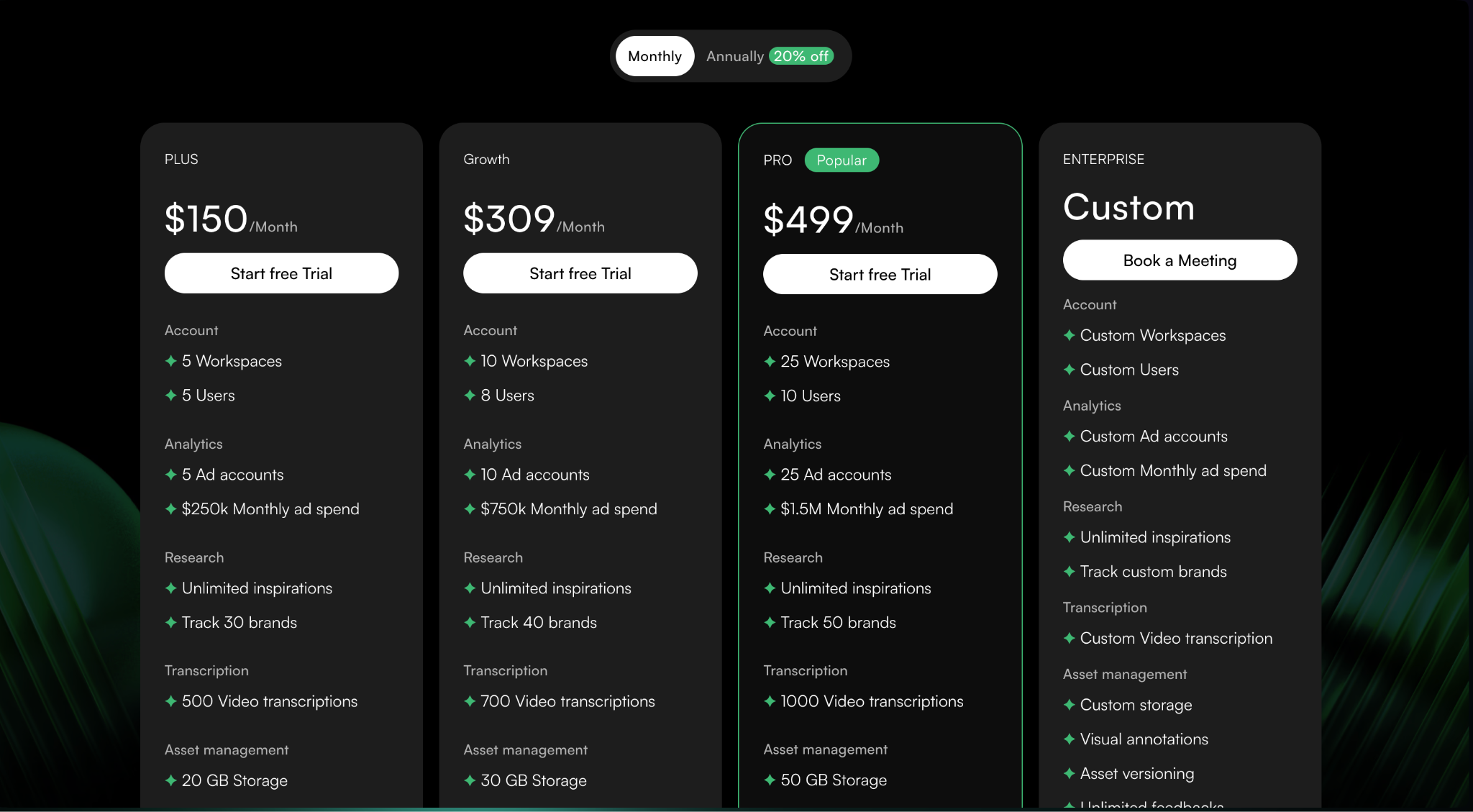
Adnova publishes its pricing. The Research + Creative Analytics tiers run from $150/month (Plus) to $499/month (Pro), with an Enterprise tier on request. The Bulk Ad Launcher is available standalone at $79/month for one ad account, with a flat $20 per additional account, ideal for agencies adding clients. Creative Hub is also available as a $39/month standalone add-on. Free trials are available without a sales call, and plans can be cancelled at any time.
Hunch does not publish pricing. The company's go-to-market is demo-driven enterprise sales, with deals sized to the customer's scale and the services component (onboarding, migration, dedicated support) included. The website emphasizes "fair pricing, no seat limits, no hidden fees," but the only path to a quote is requesting a demo.
The practical difference: a DTC brand or boutique agency can be paying Adnova and launching ads within a day. A Hunch deal will typically involve discovery calls, a custom proposal, and scoped onboarding, appropriate for the kind of customer Hunch targets, but a longer path to value for a smaller team.
Why Choose Adnova?
For Meta-first agencies and DTC founders, four things tend to matter most: speed to value, breadth of workflow coverage, predictable cost, and whether the tool actually fits the way the team already works.
Adnova is self-serve. A founder or agency owner can sign up, connect a Meta ad account, import competitor brands into Detective, save inspiration to boards, and launch their first batch of bulk ads, all in the same week, without negotiating a contract. For a team that needs to ship faster, not slower, that matters.
Workflow coverage that matches a real ad team's week. A typical week for a performance team looks something like this: research competitors, review assets, launch ads, and analyze performance. Adnova's seven modules map cleanly onto that rhythm. Hunch's strengths, catalog feeds, DPA automation, and multi-market localization, are powerful for the enterprise catalogs they're built for, but they don't address the day-to-day creative workflow most DTC brands and agencies live in.
Predictable, transparent cost. Adnova publishes its pricing. An agency adding a fifth client account knows it will cost a flat $20 more on the ad launcher. A DTC brand growing past $750K monthly ad spend knows exactly when it's time to move from Growth to Pro. There are no surprise quotes, no annual minimums hiding behind a sales call. This is the kind of pricing model independent operators tend to prefer.
Consolidation, not addition. Most teams using Adnova are replacing four to five existing subscriptions. The math tends to be straightforward: the combined cost of Motion, Foreplay, Frame.io, and a bulk launcher easily exceeds Adnova's full Pro plan. Tool consolidation also reduces onboarding overhead for new hires, fewer logins to manage, and fewer integrations to maintain.
When Hunch is the right answer. To be clear, if your business is built on a large product catalog, you run always-on localized campaigns across many markets, and your bottleneck is genuinely the manual labor of producing dynamic catalog ads at scale, Hunch is purpose-built for that. For most Meta agency founders and DTC operators, it doesn't.
See Adnova for Yourself
Start a free trial, no demo required, no credit card friction. Sign up, connect your Meta ad account, and run your first batch of ads through the platform this week.
Or book a call with the team, if you'd rather see a walkthrough first, especially for agency workflows or multi-account setups, our team will run you through the product.