


Adnova vs Brandsearch: An Honest Comparison of creative research tool


.png)
If you've ever stared at the Meta Ad Library wondering how the biggest DTC brands actually structure their funnels, what landing pages they run, what hooks they reuse, what scaling pattern lives under those creatives, you know the manual research route is broken. Ads disappear when paused, and nothing connects to the broader picture of which products are actually moving.
Two tools that solve this from very different angles are Adnova and Brandsearch. Both are credible, well-built platforms with real users and real strengths. But they're not the same product, and choosing between them depends on what you're trying to accomplish.
This is an honest look at how they compare across four things that matter: Discover, Competitor Tracking, Boards, and Swipe File creation, plus a clear explanation of what each tool actually is.
What is Adnova?
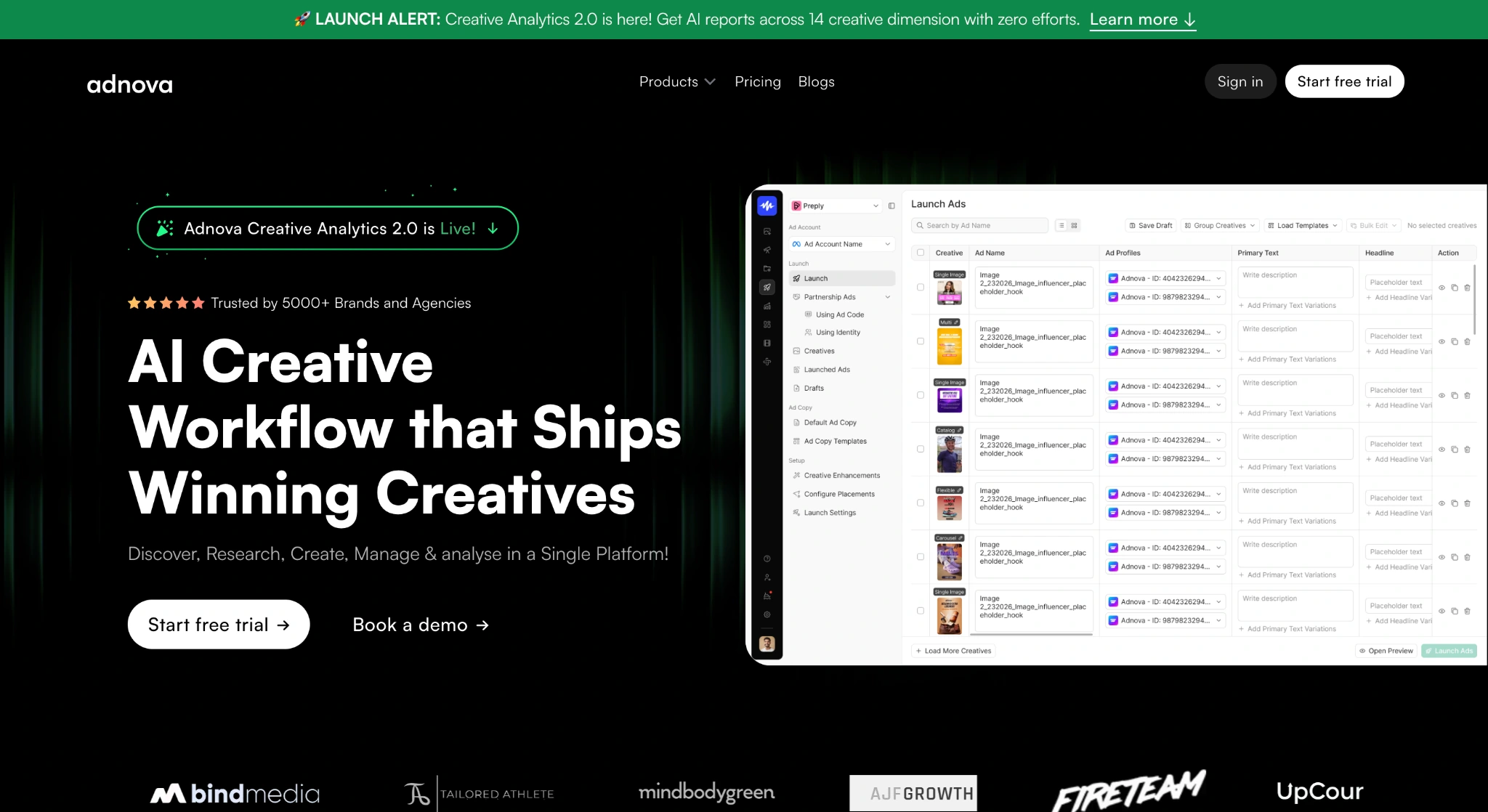
It's worth saying this up front: Adnova is not just an ad inspiration tool. It's a full creative workflow platform. Inspirations is one product and an important one but it sits inside a much bigger system designed to cover the entire lifecycle of a paid creative, from research to launch to performance analysis.
Adnova is built around five integrated modules:
- Inspirations, a 100 million ad library spanning Facebook, Instagram, TikTok, and Pinterest, with AI-powered search and organized boards.
- Brand Following automated competitor tracking with historical data, word clouds, landing page analysis, and CTA breakdowns.
- Creative Analytics turns raw Meta ad data into visual reports with top-performer comparisons, Adnova Scores, and custom metric builders.
- Creative Hub, asset management, review, and feedback with annotations, versioning, and approval workflows (a direct alternative to Frame.io or Air).
- Bulk Ad Launcher, push 100+ ads to Meta in a single click, with templated copy, CTAs, and UTM presets.
There's also a library of 2,000+ Canva and Figma-style templates layered on top. Used by 5,000+ brands and agencies, Adnova positions itself as a replacement for stacks built on Foreplay, Motion, Frame.io, MagicBrief, and others. The point is consolidation, your research, briefs, asset reviews, analytics, and launches all live in one place. Evaluating Adnova purely on inspiration features misses most of what it does.
What is Brandsearch?
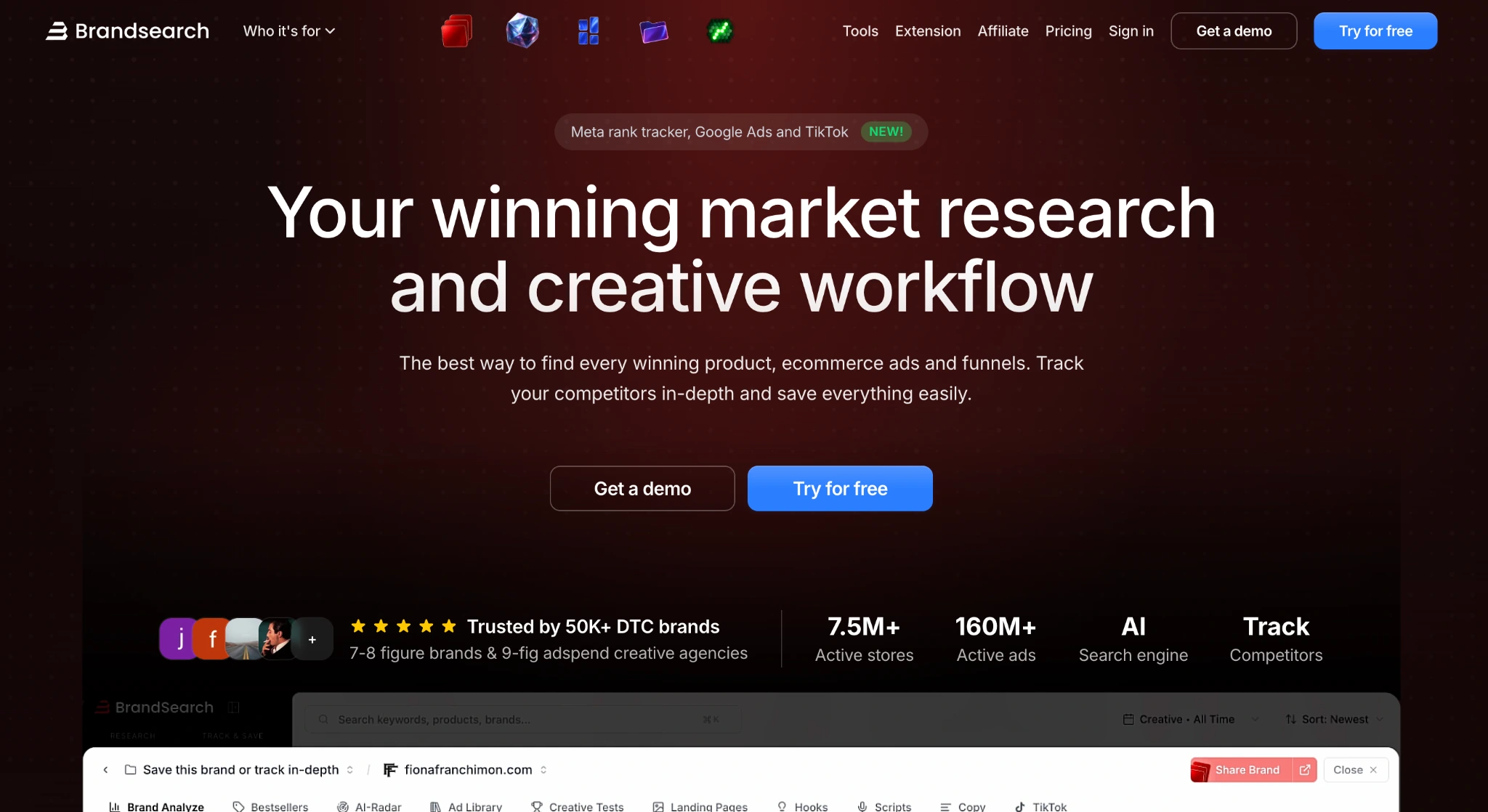
Brandsearch is an ecommerce intelligence platform built specifically for dropshippers, DTC brand builders, and creative strategists working in the Shopify ecosystem. Where Adnova spans the full creative workflow, Brandsearch goes deep on a different problem: find winning products and the brands selling them, then reverse-engineer their entire ecommerce strategy.
Brandsearch is built around five core modules:
- Brand Library. a database of 7.5M+ Shopify stores with estimated revenue, traffic sources, ad spend signals, and growth trends. This is the differentiator most other ad intelligence tools don't offer.
- Discovery, a 160M+ active ad library with AI-powered search, an Ad Rank performance metric, and the ability to filter by verified EU and UK ad spend.
- Spectre AI, automated competitor tracking that captures ads, landing pages, and funnels.
- Swipe Files, save ads, brands, landing pages, and websites via Chrome extension or a mobile app that lets you DM creatives to your library while scrolling.
- Trends, niche-level demand intelligence to spot what's gaining traction before it saturates.
Brandsearch claims 50,000+ DTC brands and 200+ agencies as users. The philosophy is clear: validate products through actual ad spend, then build around what's already working in market. A broad set of free tools layered on top, profit margin calculators, ROAS calculators, Shopify revenue estimators, pixel detectors reinforces the ecommerce-first positioning.
Adnova wants to be the operating system for your entire creative workflow. Brandsearch wants to be the deepest market intelligence layer for ecommerce brand builders. Neither is objectively better. They solve different problems for different buyers.
Discover: Searching the Ad Universe
The Discover (or Discovery) experience is the front door for most users.
Adnova's Discover taps into a roughly 100 million ad library searchable across Meta, TikTok, and Pinterest. AI search lets you query by concept rather than just keywords, with filters for niche, format, and other metadata.
Brandsearch's Discovery is significantly larger in raw scale, 160M+ active ads searchable through an AI-powered engine. Coverage spans Meta with growing support for Google Ads and TikTok organic.
The honest take: If you want a single tool spanning Meta, TikTok, and Pinterest with semantic AI search, Adnova covers more platform breadth. If you want the largest raw ad index, EU/UK ad spend filtering, and a performance ranking system at scale, Brandsearch wins on depth.
Competitor Tracking: Knowing What Your Rivals Are Doing
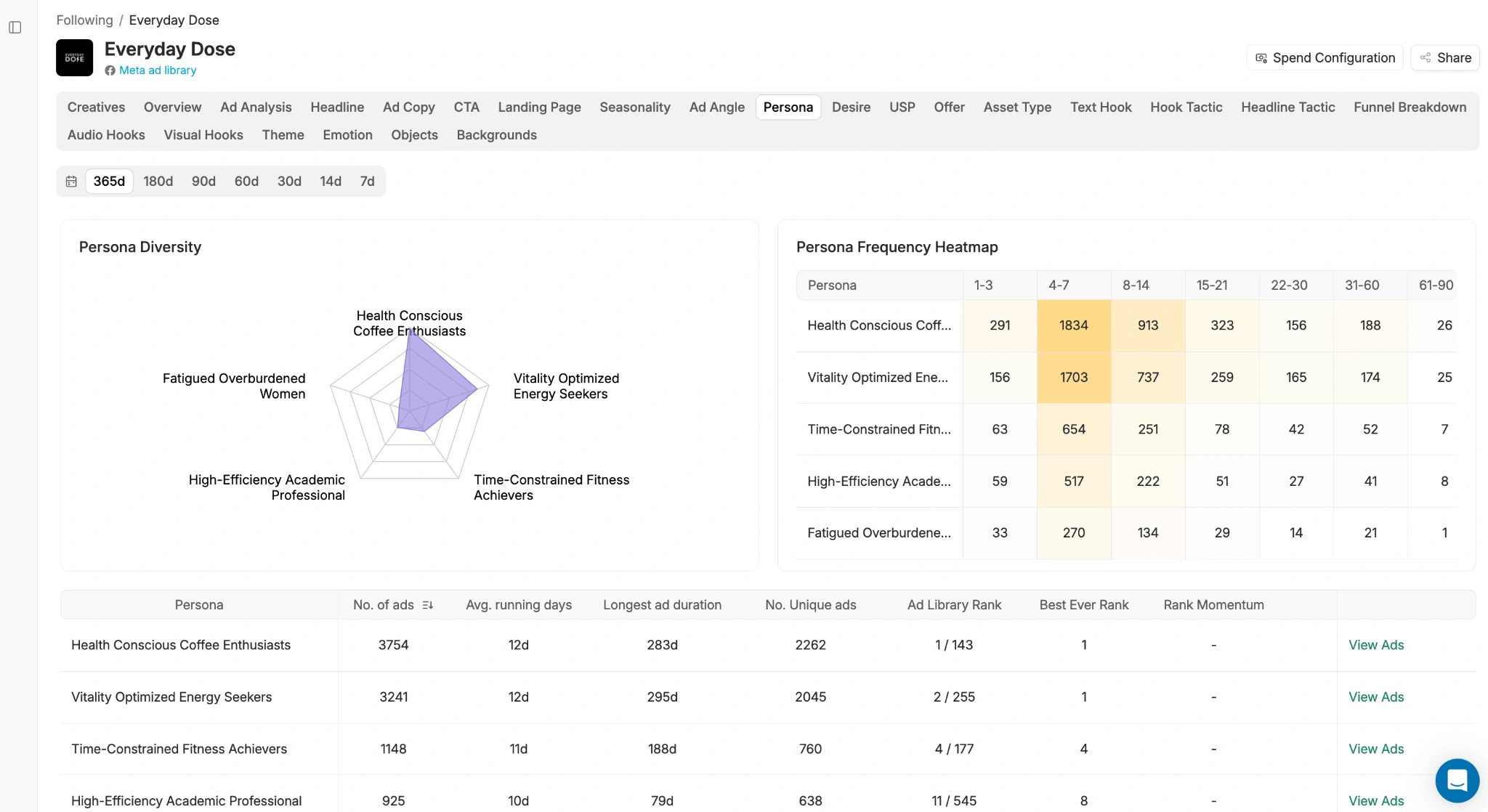
Adnova brand following is widely considered Adnova's strongest features. Pick any brand and you get a deep breakdown of their ad strategy: total creatives ever run, how many are currently active, the format split (video vs image vs carousel), AI insight into 17 creative dimensions like ad angle, persona, themes, hook tactics, funnel breakdown and more. The standout features are ad library ranking (ranking the ads based on the impression, longevity from the ad library) and the ability to estimate EU and UK ad spend data for any ads, which is genuinely useful for European brands or anyone trying to validate winners in those markets. It runs automatic monitoring, saves historical data the Meta Ad Library doesn't keep, and updates in real time.
Brandsearch Spectre AI approaches competitor tracking from an ecommerce reverse-engineering angle. It tracks every ad, landing page, and funnel a competitor runs, updated daily, with pixel-level fidelity. Winning ads and funnels are auto-saved to a library that's organized and synced 24/7. The standout feature is AI-ready JSON export, you can feed Spectre's data directly into your own AI workflows for creative analysis and pattern detection, which is unusual for tools in this category. Brand Library adds a layer most competitors don't have: estimated revenue, traffic sources, and growth trends for the brand itself, not just its ads.
The honest take: Both tools give you automated monitoring, historical data, and a way to reason about competitor strategy at scale, but they bet on different things. Brand Following bets on pre-built creative intelligence: the 17-dimension AI analysis, ad library ranking, and EU/UK ad spend estimates. Spectre bets on raw breadth and exportability: it captures the full ecommerce machine, ads, landing pages, full funnels, brand-level revenue and ships it as structured JSON. If you want decision-ready creative insights out of the box, adnova wins.
Boards: Organizing What You Find
Adnova's boards are hierarchical. You can create boards and sub-boards, save the same ad to multiple workspaces and boards, and add visual annotations directly on creatives. Sharing is enterprise-grade: password-protected board links with expiry control. For agencies juggling many clients in separate workspaces, this depth matters.
Brandsearch's organization sits inside the Swipe Files module rather than as a separate boards feature. Saves are organized into folders with tags and filters, designed for team collaboration. The model is "share concepts, not screenshots" you can tag, filter, and brief your team without exporting anything externally. It's simpler than Adnova's nested structure but covers the essentials for most ecommerce teams.
The honest take: Adnova's board system has more architectural depth, sub-boards, password-protected client sharing, on-creative annotations. This is built for agency setups managing many clients with strict access controls. Brandsearch's organization is flatter and designed for in-house DTC teams where nested hierarchies aren't worth the overhead.
Swipe File Creation: Building Your Permanent Library
A swipe file is your long-term creative memory. Both tools handle this well with different emphases.
Adnova's Inspirations functions as a swipe file system, though it isn't branded that way. The Chrome extension saves ads from Facebook Ad Library, TikTok Creative Center, and Pinterest in one click, Instagam and Tiktok organic capturing full metadata: images, copy, advertiser info, and landing pages. Ads are stored permanently in the cloud, accessible even after the source ad expires. Annotations and password-protected sharing turn the swipe file into a collaboration artifact rather than just an archive.
Brandsearch's Swipe Files is explicitly branded and supported by an interesting capture surface area:
- Chrome extension for one-click saves from Facebook, TikTok, and beyond.
- Mobile app that lets you DM winning ads to your library while scrolling on your phone. This is a workflow few competitors offer and matters more than it sounds most creative inspiration happens on mobile, not desktop.
- Saves include landing pages and full websites, not just ads. You can capture an entire competitor funnel into your swipe file rather than just the creative.
- Team sharing with tagging, filtering, and briefing built in.
The honest take: Both deliver permanent, searchable archives that survive ads going offline. Adnova adds collaboration depth (annotations, password-protected sharing) that matters for client-facing work. Brandsearch wins on capture flexibility, the mobile app and the ability to save full landing pages and websites are genuinely useful workflows Adnova doesn't match.
Pricing: What You'll Actually Pay
Adnova prices by ad spend caps and team size with modular add-ons. Brandsearch prices by seats and Spectre brand tracking limits.
Adnova has a tiered Research + Creative Analytics plan, with the Ad Launcher and Creative Hub sold separately:
- Free : 1 user, 1 ad account, $25K monthly spend cap.
- Plus : $150/mo: 5 users, 5 ad accounts, $250K spend, track 30 brands.
- Growth : $309/mo : 8 users, 10 ad accounts, $750K spend, track 40 brands.
- Pro : $499/mo: 10 users, 25 ad accounts, $1.5M spend, track 50 brands.
- Enterprise : custom.
- Add-ons: Ad Launcher from $79/mo annual (+$20/mo per extra ad account); Creative Hub standalone at $39/mo.
Annual saves 20%. Note: AI add-ons (AI Tagging, AI Competitor Reports, AI Inspiration Search) are priced separately, not bundled.
Brandsearch has three tiers (prices shown on-site with a 20-25% discount applied):
- Starter : $79/mo: 1 seat, 15K stores in Brand Library, 5 brands in Spectre.
- Outscaler: $99/mo: 2 seats, unlimited Brand Library, 50 brands in Spectre.
- Agency : $200/mo: 5 seats, unlimited Brand Library, 100 brands in Spectre, API access.
The honest take: At entry level, Brandsearch is meaningfully cheaper, Starter at $63/mo vs Adnova Plus at $119/mo annual. But it's not apples-to-apples: Adnova's Plus includes Creative Analytics, asset management, and templates Brandsearch doesn't compete on. If you'd otherwise pay separately for Motion (analytics) and Frame.io (asset review), Adnova's bundle can come out cheaper despite the higher sticker. If you just need research and swipe files at scale, Brandsearch is leaner.
So Which One Should You Choose?
Choose Adnova if:
- You need a full creative workflow platform, not just an inspiration tool, research, asset review, analytics, and bulk ad launching all in one place.
- You're an agency managing multiple client workspaces and need sub-boards, password-protected client sharing, and annotation-based collaboration.
- You want to consolidate your stack, replacing Foreplay, Motion, Frame.io, and others with one tool.
- Your competitor research benefits from linguistic analysis (word clouds, CTA breakdowns, historical data).
- You research ads across Meta, TikTok, and Pinterest.
Try Before You Commit
Both Adnova and Brandsearch offer ways to evaluate the product before paying. If you're still on the fence, the highest-leverage thing you can do is spend 30 minutes inside each with a real research question from your current week.
Start your free trial and see how much time you can reclaim for strategy and client relationships.
Or, if you'd prefer a personalized walk-through tailored to your agency's specific workflow, book a consultation call with our team. We'll show you exactly how adnova fits into your operation.
Your team's time is your most valuable asset. Make sure it's being spent on work that matters.