

Creative Fatigue in Facebook Ads: What's Killing Your ROAS and How to Fix It


.png)
The success of a Facebook campaign does not depend solely on reaching the target audience or increasing the budget. Fb ads creative fatigue is one of the major reasons for poor performance. There is always a tendency for many advertisers to stick with one creative strategy for way too long. This causes the audience to overlook the ads, making conversions more costly.
Today, companies spend billions on Meta advertising each year. According to industry reports, the average person is exposed to thousands of ads each day across all platforms. This means your audience will quickly get bored of seeing the same ad. If you do not change up your creatives regularly, your campaign's effectiveness may decline in just a few days.
How to Fix It Fast
If you realize that your media is not doing well, you have to take prompt action. However, you should never remove the entire structure of your campaign. You just need to update your media to resolve the problem.
What to Swap First - Hook, Visual, or Copy
When revising a Facebook ad, focus on the assets that have the greatest impact. Don't try to do too many things all at once. Follow these steps to revise an ad quickly:
- The Hook (First 3 Seconds or Top Visual): It is the most important aspect. If you are going with video content, change the opening sequence or add a larger text overlay. With still-image ads, adjust your focal point or background color. Changing the hook can instantly boost CTRs.
- The Core Visual Style: If changing the hook does not help, then try altering the entire format. If you were using a polished product photo, try using a UGC video format. By doing this, you will be able to target diverse customers.
- The Body Copy and Headlines: Change the text last of all. Make your text short, concentrating on another customer problem, or use a list of the product's advantages. Make your headlines concise and related to your offer.
Broadening Audience and Using Advantage+ Correctly
One simple solution to overcoming asset exhaustion is to provide a platform space for buyers to find. If your budget is locked into small audiences, such as lookalike or interest audiences, then widen your targeting options.
Use a broad target audience without filtering out any interests, based solely on age, location, and gender. As you have more people, your frequency will decrease. Another option would be to use Meta's Advantage+ shopping ads. This tool offers complete automation for targeting and budget distribution at the network level.
Using Advantage+ campaigns requires adding multiple ad formats, such as carousel, video, and image ads. It will also provide each user with the best asset format, reducing the risk of violating the creative limited facebook ads restriction.
How to Detect It Early
There is no need for you to guess whether your media will fail. All the information you need will be available in the analytics within your account, so you can discover asset issues before they ruin your monthly profits.
Four Metrics That Signal Fatigue First
To identify visual exhaustion early, pay close attention to these four measures in your ad manager dashboard:
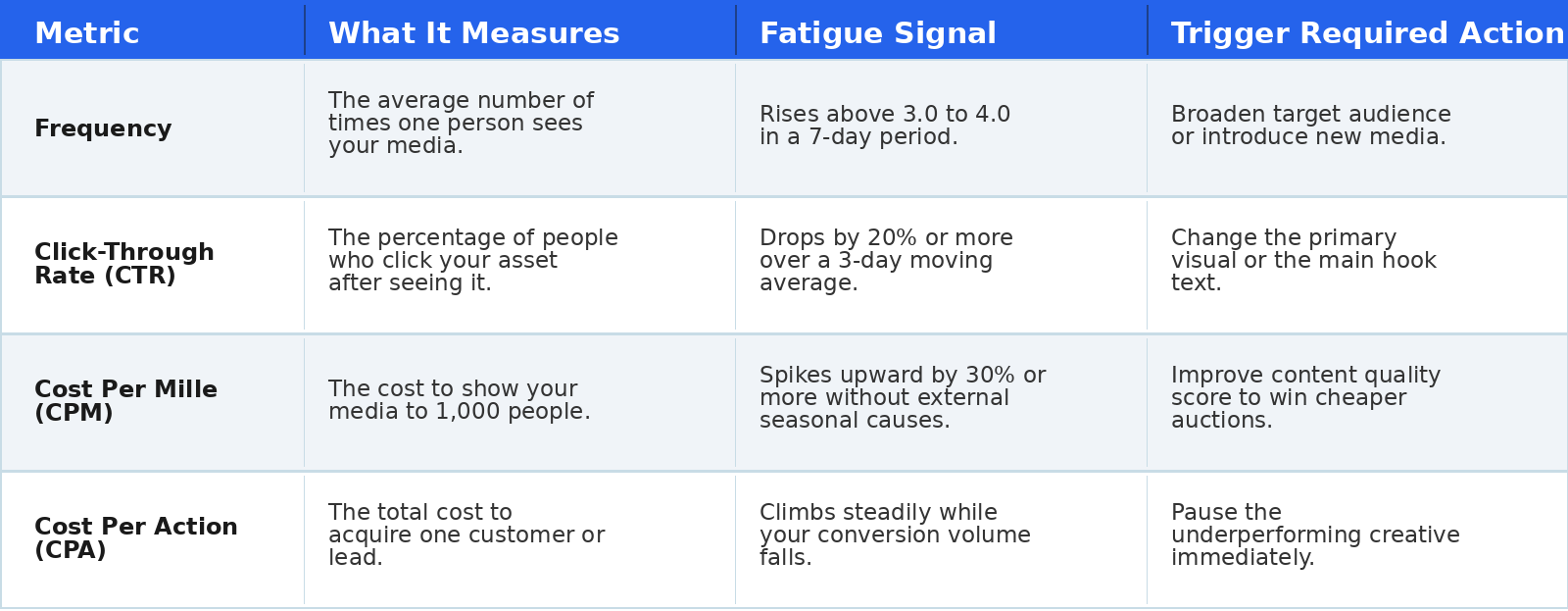
These indicators will change in a specific manner when you experience Fb ads creative fatigue. First, the frequency will increase since the ad is shown repeatedly to the same audience. The second thing that will happen is a decline in the click-through rate. If your CTR decreases, Meta will understand that people don't like what you've posted, so they will raise your CPM. Finally, your CPA will increase, which means you'll make no money at all.
Meta's Native Warnings and Automated Alerts
The advertising platform has internal tools to help you identify bad assets. In the delivery column, you may find a tag labeled creative limited Facebook ads. This tag appears when your cost per result is higher than your past ads but still less than double. If your cost per result climbs to double or more, the tag changes to creative fatigue. Keep in mind this warning usually shows only on ad sets running a single creative. Either label is a signal to refresh your media before delivery and costs worsen further.
You could also set up automated alerts to catch such cases. You could set up an alert to notify you via email, or pause the asset if its frequency is above 4.5 and its CTR is less than 1%. Automated rules will be your safeguard, protecting your budget when you are not reviewing the dashboard yourself.
Why It Happens
To fix performance issues, you have to find out why they occur. Many media buyers think that their audience targeting is bad. However, the problem is usually the visual content itself. Let's consider in more detail what makes a creative asset unprofitable on the platform.
Audience-Budget Mismatch and Creative Similarity
A major cause of performance loss is the inconsistency between your budget and your market size. If you allocate $500 per day to target a market of 50,000, everyone will see your media very often. High spending on small groups leads to rapid visual fatigue.
Creating a new version that appears identical to the previous one can be another problem. Changing just one word in the title or using a different shade of blue will go unnoticed by your target audience. The consumer is presented with something that seems to be the same message from the same brand as before. The result is a decline in engagement at an early stage, because the consumer has had enough of the same visuals.
Single Format Dependency and No Refresh Cadence
Most brands rely entirely on one media style, such as stills or video reels. If your marketing campaign relies solely on stills, you will lose users who love watching videos. Dependency on a single file format narrows your range and speeds up creative fatigue meta issues. The algorithm cannot effectively optimize across various placements if you present it with only one media file format.
Additionally, many businesses rarely have a fixed timetable for renewing their visual elements. They only create these elements after a marketing campaign has become completely ineffective. This leads to long gaps with low sales. Your business can never succeed in an environment where sales performance suddenly falls.
Building a Rotation System
The best way to handle asset exhaustion is to prevent it. A good brand will create an ongoing cycle mechanism. This allows for new assets to operate without interfering with the ongoing campaign or ad sets.
The Staggered Launch Model
Do not launch all your creative ideas at once. When you introduce 10 new assets at once into the group, most of the budget is spent on just one or two assets, while the rest is wasted. This must be avoided and should be done in a phased manner.
Test new ideas in a test environment at minimal cost. If you find a variation that delivers steady conversions at a low cost, add this asset to your scaling process. Keep introducing a new winner at an interval of 7 to 14 days, and retire the oldest asset with the highest CPA. This technique helps keep your primary configuration up to date with top performers.
Organizing Your Creative Library
A fast rotation system requires a highly organized digital asset library. You cannot possibly expect rapid updates when you have to search disorganized desktop folders and messaging platforms to find a single video file. Organize your database according to concept, form, and angle.
Organize your media files by labeling them in a way that makes sense, like "UGC_Unboxing_Angle1" or "Static_ProblemSolved_Angle2". Keep records of when they were launched and their performance history on an Excel sheet. A clean library allows you to access the best-performing historical assets, modify them, and reuse them whenever the current live variations start to decline.
Conclusion
Fb ads creative fatigue is one of the critical factors that are often ignored yet are capable of influencing ROAS, even for the highest-performing ad campaigns. Frequent ad fatigue manifests itself through increased frequency, low CTR, higher CPM, and increasing CPA.
Creative fatigue can be minimized by constantly renewing creatives, testing different advertisement formats, increasing their reach, and implementing a robust rotation plan. Companies that track their performance and remain innovative will probably do better and have higher conversion rates.
Advertising tools like Adnova make managing creative fatigue much easier. Adnova brings creative analytics, an ad inspiration library, competitor tracking, asset management, and a bulk ad launcher into one platform, so you can spot underperforming creatives early, keep your library organized, and launch fresh variations for your Meta campaigns in a single click. Pairing a strong rotation strategy with a tool like this helps increase long-term ROAS while cutting wasted ad spend.
FAQs
- How often should I add new creative assets to my Meta campaigns?
If you have a smaller or moderate budget, refreshing your ads every two weeks would be sufficient. In high-budget campaigns that cost you thousands of dollars each day, you might want to refresh your visuals once or twice per week.
- What frequency number indicates that an ad is failing?
Though there is no specific figure, any frequency above 3.5 or 4.0 over 7 days will increase the acquisition cost. If you have a high frequency but the cost is still low, keep using it. However, if costs are rising, it's time to replace it.
- Does a high CPM always mean my creative assets are fatigued?
Not always. Costs could increase due to competition during holiday shopping seasons, such as Black Friday. But if costs have increased in an ordinary week when click-through rates are decreasing, then your audience has definitely become tired of that particular creative.